Home » Academic projects » It takes a Village: Reimagining Cooperative Living for Single Mothers and Children | Bachelors Design Project on Urban Housing
It takes a Village: Reimagining Cooperative Living for Single Mothers and Children | Bachelors Design Project on Urban Housing
Excerpt: ‘It takes a Village: Reimagining Cooperative Living for Single Mothers and Children’ is a Bachelors Design Project by Crystal Giard, Grace Rankin, and Xiluva Mbungela from the School of Architecture – Syracuse University that seeks to redefine the domestic environment and explore urban housing to help support single mothers and their children. It envisions homes as multifunctional spaces that blend life, work, and play through a design strategy that values the flexibility of a space, enhancing mental health and well-being for all residents.
Introduction: It takes a village to raise a child. This sentiment becomes more prevalent as it becomes clear that community connection and general mental health cannot be sustained by the isolation caused by the nuclear family model. As a result, this project proposes redefining the domestic environment and exploring cooperative living’s potential to help support single mothers and their children. With virtual communications enabling us to work from home and leading to a more nomadic lifestyle, technology further blurs the definition of home. Consequently, homes must now be designed as spaces for intersections of life, work, and play as well as for domestic life.
This project adopts a design strategy that values the flexibility of a space in response to these factors. The integration of the interior and exterior is made possible by a tiered environmental system that takes advantage of passive heating and cooling strategies. This system creates greenhouse spaces that function as an outdoor extension of the home, much like an urban backyard.
Situated at 1650 Madison Ave, East Harlem, New York City, the site was one of several unoccupied public lots since its size was not ideal for development. This small stretch of land provides an invaluable opportunity to experiment with new forms of domestic living and collective ownership within an urban landscape. The proposed housing development is a mixed-use residential building with a daycare center and an indoor play space on the ground floor.
Isometric in Site Context
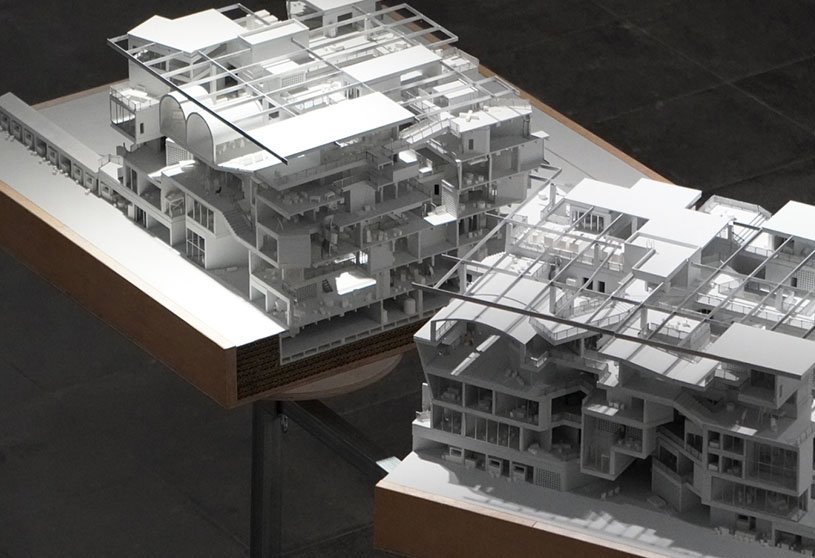
The students observed that there was the most opportunity to experiment with form by responding to daylighting. In order to optimize the greenhouse areas, the entire building adopts a tiered plan, with the atrium bringing light into the lower floors. Dissolving the corner allows more light to enter the building and visually connects the small, cantilevered sections that arise from this decision.
Final Outcome
Ground Floor Plan, Daycare and indoor playgroundFirst Floor Plan, ResidencesIsolated IsometricPerspective, Greenhouse Exterior | Structural Bay Model
This project serves as evidence that emphasising play while designing for environmental considerations can be a meaningful way to redefine contemporary perceptions about the home. These are the kinds of places where kids can play outside come rain or shine, where cookouts can happen, or where potted plants can grow suspiciously big and take over. The urban backyard can be used year-round as a seasonal area by incorporating passive strategies that contribute to a comfortable atmosphere and encourage residents to utilise shared spaces and engage in cooperative living.
Floor PlansStructural Frame ModelStructural Bay Model Closeups
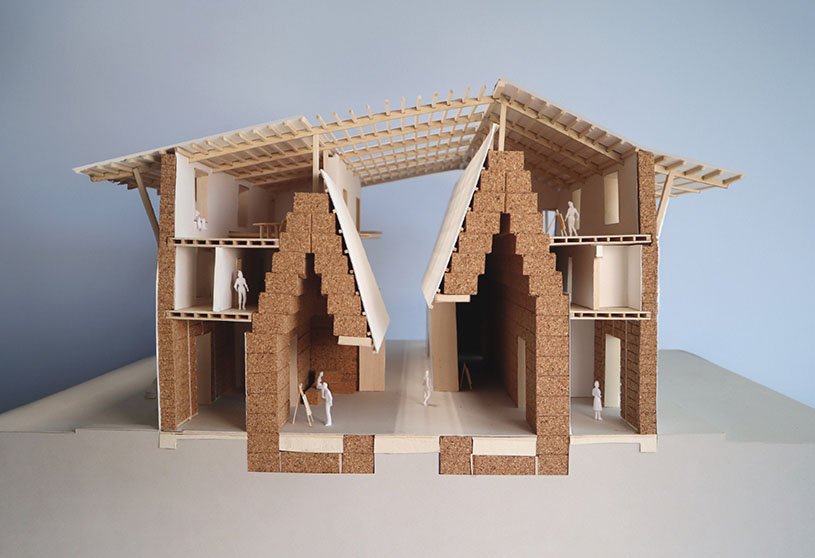
The structure is a simple steel frame grid with circulation cores made of concrete. CLT panels are slid into the steel structure for flooring. The facade is a polycarbonate curtain wall that is supported up by a steel frame. The polycarbonate acts as its own self-supporting structure, and it is complemented by a secondary aluminium metal frame. The goal for the structure is something simple and easy to manipulate, and by using the grid of the steel framing it was possible to selectively carve away to create a vast atrium, two cantilevered spaces, and large patio spaces without adding complexities to construction.
Design Strategies
Program OrganizationConcept Model, Varying Angles
Massing, fenestration, cladding, and materiality were all intended to be both highly functional and expressive in this project. To accommodate various programmatic uses, the building is divided into three types of enclosures. Private living takes place in the first environment, also known as “the core.” This space is thermally controlled by wood-paneled stud walls and an outer wall covered in brick. Little niches between rooms offer a semi-private space that functions as an interior porch.
Isolated IsometricPerspective, Greenhouse Interior | Perspective, Daycare and Playground Exterior
The communal spaces with living rooms and kitchens are situated in the second environment. A set of glass folding doors that open up to enclose these spaces and make them blend into the third environment encircles them. In order to create the urban backyard, the third environment offers a particularly flexible space that combines interior and exterior needs. Enclosed in a polycarbonate shell with an automated roof system and manually operated windows, these spaces rely on passive heating strategies.
Environmental Analysis in Plan
Different enclosure levels provide seasonal adaptability while collaborating with programmatic boundaries. The polycarbonate shell is completely operable in the summer and uses the stack effect to provide cooling and ventilation. The second environment opens up into the greenhouse spaces in the spring and autumn, reducing the need for mechanical energy because of passive strategies. In winter, the enclosure closes up again.
Environmental Section showing Heating and Cooling Strategies
While the shared areas and core are closed off and mechanically heated by radiant floors, the greenhouse space still provides an outdoor space for play and outdoor activities like cookouts and campfires. In addition to serving as a buffer climate, the mechanical heat recovery system in the greenhouse collects and circulates heat lost from the shared spaces.
Conclusion: The project addresses the lack of community support for single mothers and their children by promoting cooperative living. It envisions homes as multifunctional spaces that blend life, work, and play through a design strategy that values the flexibility of a space, enhancing mental health and well-being for all residents.
[This Academic Project has been published with text submitted by the student]
Site Context
Final Outcome
To submit your academic project for publication at ArchiDiaries, please visit the following link >> Submit
Get the best of ArchiDiaries, directly in your inbox.
We use cookies on our website to give you the most relevant experience by remembering your preferences and repeat visits. By clicking “Accept All”, you consent to the use of ALL the cookies. However, you may visit "Cookie Settings" to provide a controlled consent.
This website uses cookies to improve your experience while you navigate through the website. Out of these, the cookies that are categorized as necessary are stored on your browser as they are essential for the working of basic functionalities of the website. We also use third-party cookies that help us analyze and understand how you use this website. These cookies will be stored in your browser only with your consent. You also have the option to opt-out of these cookies. But opting out of some of these cookies may affect your browsing experience.
Necessary cookies are absolutely essential for the website to function properly. These cookies ensure basic functionalities and security features of the website, anonymously.
Cookie
Duration
Description
cookielawinfo-checkbox-analytics
11 months
This cookie is set by GDPR Cookie Consent plugin. The cookie is used to store the user consent for the cookies in the category "Analytics".
cookielawinfo-checkbox-functional
11 months
The cookie is set by GDPR cookie consent to record the user consent for the cookies in the category "Functional".
cookielawinfo-checkbox-necessary
11 months
This cookie is set by GDPR Cookie Consent plugin. The cookies is used to store the user consent for the cookies in the category "Necessary".
cookielawinfo-checkbox-others
11 months
This cookie is set by GDPR Cookie Consent plugin. The cookie is used to store the user consent for the cookies in the category "Other.
cookielawinfo-checkbox-performance
11 months
This cookie is set by GDPR Cookie Consent plugin. The cookie is used to store the user consent for the cookies in the category "Performance".
viewed_cookie_policy
11 months
The cookie is set by the GDPR Cookie Consent plugin and is used to store whether or not user has consented to the use of cookies. It does not store any personal data.
Functional cookies help to perform certain functionalities like sharing the content of the website on social media platforms, collect feedbacks, and other third-party features.
Performance cookies are used to understand and analyze the key performance indexes of the website which helps in delivering a better user experience for the visitors.
Analytical cookies are used to understand how visitors interact with the website. These cookies help provide information on metrics the number of visitors, bounce rate, traffic source, etc.
Advertisement cookies are used to provide visitors with relevant ads and marketing campaigns. These cookies track visitors across websites and collect information to provide customized ads.